materials / anchors

Drywall Anchor Mistakes and Weight-Rating Misunderstandings

A conservative guide to common anchor mistakes: treating package ratings as universal, skipping wall condition, using anchors where verified support matters, and ignoring failure consequence.

Researcheddocs and sources
Risk: medium

Quick answer

Drywall anchor ratings are not universal permission. Listed performance depends on the exact product, wall material and condition, screw size, installation, load direction, and manufacturer instructions. The biggest mistake is choosing the strongest-looking anchor before asking whether the wall is sound, whether verified support is required, and what happens if the object falls.

Best for

  • readers comparing anchor choices conservatively
  • beginners confused by package ratings
  • wall-hanging decisions where failure consequence matters

Who should skip this

  • numeric load-rating tables
  • product ranking or endorsement
  • TV, cabinet, grab bar, overhead, or child-safety approval
  • substituting anchors for verified support

Conservative boundary

When not to DIY

  • The wall is wet, soft, mold-suspect, crumbling, repeatedly patched, or already torn out.
  • The wall type is unknown or the product is not clearly compatible with that wall.
  • The object is heavy, overhead, child-adjacent, above a bed or walkway, or otherwise high-consequence.
  • The anchor choice is based only on a package number, online comparison, or stronger-looking hardware.

Conservative boundary

Stop here if...

  • An anchor spins, pulls out, tears paper, or makes the hole oversized.
  • You are stepping up to larger anchors in the same damaged spot without a product-supported repair path.
  • You are doing math to justify a high-consequence object instead of verifying support.
  • The wall condition, screw size, hole size, cavity clearance, or installation method does not match the exact instructions.

Evidence note

Evidence note: This article is researched from manufacturer instructions and safety references. Before You Drill has not performed product testing or jobsite verification for this guide.

Why weight ratings are easy to misuse

Drywall anchor packages can make the decision look simple: find a bigger number, buy the stronger anchor, and hang the object. That is not how a careful wall decision works.

An anchor rating belongs to a specific product under specific conditions. It does not automatically apply to every wall, every screw, every load direction, every installation, or every object. The surrounding drywall can fail before the anchor does. A sloppy hole, weak wall, damp area, old patch, wrong screw, or high-consequence placement can make the package number less useful than it looks.

Use ratings as one researched clue, not as permission.

Mistake 1: starting with the highest number

The strongest-looking anchor is not always the right anchor. Larger or more complex anchors can need larger holes, more cavity clearance, and cleaner installation. If the job is a light picture or small decor item, a heavy-duty toggle may create unnecessary wall damage. If the job is a TV, cabinet, grab bar, overhead object, or large mirror, a drywall anchor may still be the wrong starting point.

Start with the object, the wall, and the failure consequence. Then read the exact manufacturer instructions. The best answer may be a simple hanger, a stud-based method, a different mounting location, or stopping before DIY.

Mistake 2: ignoring wall condition

Drywall anchors need sound wall material around them. Patched drywall, water-damaged drywall, soft drywall, crumbly edges, repeated failed holes, and old anchor tear-outs are not the same as clean drywall. If the wall has already failed once, installing a larger anchor in the same damaged area may make the repair worse.

Before installing any anchor, look for staining, bubbling paint, softness, chalky edges, loose paper, or dampness. If the wall is not firm and dry, stop. Do not use hardware to hide a wall-condition problem.

Mistake 3: using drywall anchors on the wrong wall type

Drywall anchors are for drywall conditions that match the product instructions. Plaster, tile, masonry, brick, concrete block, paneling, and layered walls may need different fasteners or a different decision entirely.

If the product says it is designed for drywall only, do not stretch that claim to plaster, tile, or masonry. If a product lists several compatible surfaces, still read the instructions for the exact wall, screw, drill size, hole depth, and installation method. Compatibility is not a blank check.

Mistake 4: assuming multiple anchors automatically add up

Multiple fasteners can help distribute some loads when the product and object are designed that way, but you should not assume the capacity simply adds up. Some product instructions specifically limit compatible uses or warn that using multiple hangers is not cumulative.

Even when multiple fasteners are allowed, the object, wall, bracket, screw, spacing, load direction, and installation quality all matter. If the object is consequential enough that you are doing math to justify it, step back and ask whether verified support or qualified help is the better decision.

Mistake 5: using anchors instead of verified support

For shelves, mirrors, cabinets, TVs, grab bars, climbing-prone furniture, and overhead objects, the consequence of failure can be more important than the anchor category. CPSC tip-over guidance is useful here because it shows that TVs and furniture can be a serious child-safety risk when they are not properly secured. That is a different risk category from hanging a light frame.

If failure could injure someone, block a walkway, damage expensive equipment, or create a child-safety issue, do not treat a drywall anchor rating as final approval. Look for manufacturer mounting instructions, verified support, anti-tip instructions where relevant, bracket requirements, and appropriate qualified judgment.

Mistake 6: making the hole bigger after failure

When an anchor spins, pulls out, tears the paper, or makes the hole oversized, stop. Do not keep stepping up to larger anchors in the same damaged spot unless the product instructions and wall condition clearly support that repair path.

An anchor failure is information. It may mean the wall is weak, the hole was wrong, the screw was wrong, the load was wrong, or the anchor was not appropriate. The next step may be patching the wall, moving the location, finding verified support, or rethinking the object, not forcing more hardware into a damaged area.

What to check before buying anchors

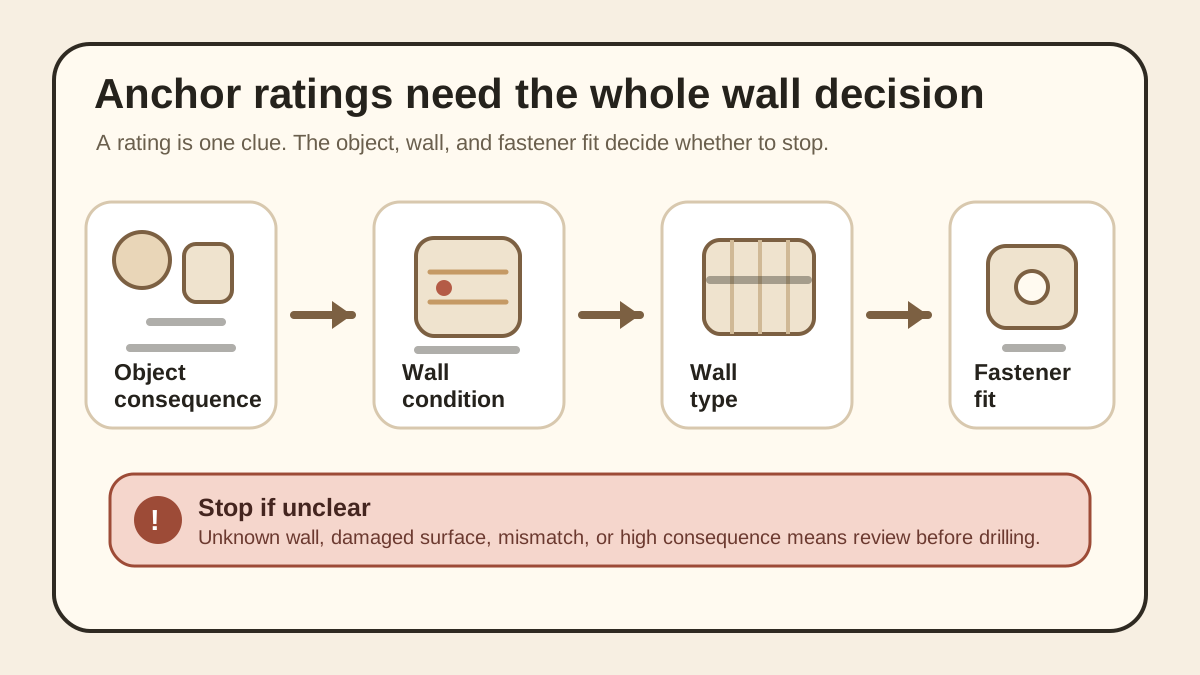
Before buying anchors, write down five things: what you are hanging, where it will sit, what wall type you have, what the wall condition looks like, and what happens if the object falls.

Then read the product instructions before assuming the package number applies. Check compatible surfaces, screw size, drill size, wall thickness, cavity clearance, load direction, installation steps, and warnings. If any of those details do not match your wall, do not round up the rating.

Stop rules

Stop if the wall is wet, soft, mold-suspect, crumbling, repeatedly patched, or already torn out. Stop if the wall type is unknown, the product is not clearly compatible with the wall, the object is heavy or high-consequence, or the anchor choice is based only on a package number or online comparison.

Stop for TVs, cabinets, grab bars, overhead objects, large mirrors, child-safety anchoring, masonry, tile, plaster uncertainty, suspected wiring, suspected plumbing, suspected gas lines, structural movement, and any location where failure would be more than a small cosmetic problem.

Next step: pair this with the anchor guide and pre-drill checklist

Use the Drywall Anchors Explained guide for a plain-English comparison of plastic expansion anchors, self-drilling anchors, toggle bolts, and molly-style anchors. Then use the Before You Drill checklist before making a hole.

If the wall type is uncertain, read the wall-type guide first. If you are using a stud finder to locate support, read the false-positives guide before trusting one beep.

What can go wrong

  • The anchor suits the package description but not the actual wall condition.
  • Weak, damp, patched, or damaged drywall fails before the anchor itself.
  • Multiple fasteners are assumed to add capacity without exact product and object instructions.
  • A high-consequence object is reduced to a package rating instead of support verification.

What this is based on

  • Manufacturer-specific anchor compatibility, installation, and rating conditions.
  • Conservative framing for multiple fasteners, high-consequence objects, and damaged wall conditions.
  • Safety references for tip-over consequence, moisture/mold stop rules, and hidden-service drilling risk.

Evidence notes

Sources and claim support

Drywall anchor claims and ratings are manufacturer, product, installation, and wall-condition specific, not universal permission.

medium confidenceSafety-sensitive
  • SnapSkru Self-Drilling Drywall Anchor
  • SnapSkru Self-Drilling Drywall Anchors technical PDF
  • SNAPTOGGLE Heavy-Duty Toggle Bolt - Carbon Steel

Some anchor products require specific wall thickness, screw size, hole size, cavity clearance, or installation method.

medium confidenceSafety-sensitive
  • SnapSkru Self-Drilling Drywall Anchor
  • SnapSkru Self-Drilling Drywall Anchors technical PDF
  • SNAPTOGGLE Heavy-Duty Toggle Bolt - Carbon Steel
  • 3M CLAW Heavyweight Hanging Solution

Multiple fasteners or hangers should not be assumed to make capacity cumulative unless the exact product instructions say so.

medium confidenceSafety-sensitive
  • 3M CLAW Heavyweight Hanging Solution

TVs, furniture, child-safety, and tip-over contexts are high-consequence and must follow manufacturer instructions.

medium confidenceSafety-sensitive
  • AnchorIt.gov

Wet, damp, water-damaged, or mold-suspect wall conditions are stop conditions before anchoring or cosmetic repair.

high confidenceSafety-sensitive
  • A Brief Guide to Mold, Moisture and Your Home

Hidden electrical, plumbing, or gas risks are stop-rule conditions only.

medium confidenceSafety-sensitive
  • Do-It-Yourself (DIY) Electrical Safety

Masonry and concrete anchors require product-specific instructions and should not be treated as drywall-anchor equivalents.

medium confidenceSafety-sensitive
  • Tapcon Installation Instructions 3/16 and 1/4

Source list

  • SnapSkru Self-Drilling Drywall AnchorTOGGLER · manufacturer-spec · accessed 2026-06-19Local evidence path: outputs/source-evidence/articles/a13-drywall-anchor-mistakes/p2-265/a13-s01-toggler-snapskru.html
  • SnapSkru Self-Drilling Drywall Anchors technical PDFTOGGLER / Wej-It · manufacturer-spec · accessed 2026-06-19Local evidence path: outputs/source-evidence/articles/a13-drywall-anchor-mistakes/p2-265/a13-s02-toggler-snapskru-pdf.note.md
  • SNAPTOGGLE Heavy-Duty Toggle Bolt - Carbon SteelTOGGLER · manufacturer-spec · accessed 2026-06-19Local evidence path: outputs/source-evidence/articles/a13-drywall-anchor-mistakes/p2-265/a13-s03-toggler-snaptoggle.html
  • 3M CLAW Heavyweight Hanging Solution3M · manufacturer-spec · accessed 2026-06-19Local evidence path: outputs/source-evidence/articles/a13-drywall-anchor-mistakes/p2-265/a13-s04-3m-claw.html
  • AnchorIt.govCPSC · official-guidance · accessed 2026-06-19Local evidence path: outputs/source-evidence/articles/a13-drywall-anchor-mistakes/p2-265/a13-s05-cpsc-anchorit.note.md
  • A Brief Guide to Mold, Moisture and Your HomeEPA · official-guidance · accessed 2026-06-19Local evidence path: outputs/source-evidence/articles/a13-drywall-anchor-mistakes/p2-265/a13-s06-epa-mold-moisture.html
  • Do-It-Yourself (DIY) Electrical SafetyElectrical Safety Foundation International · official-guidance · accessed 2026-06-19Local evidence path: outputs/source-evidence/articles/a13-drywall-anchor-mistakes/p2-265/a13-s07-esfi-diy-electrical-safety.html
  • Tapcon Installation Instructions 3/16 and 1/4Tapcon · manufacturer-spec · accessed 2026-06-19Local evidence path: outputs/source-evidence/articles/a13-drywall-anchor-mistakes/p2-265/a13-s08-tapcon-installation-instructions.note.md

Checklist support

Keep the decision path concrete

Checklist

Before You Drill Into a Wall: Beginner Checklist

A stop-first checklist for wall type, placement, fastener choice, and measurement before making the first hole.

Checklist

TV Mounting Photo Prep Checklist

The room, wall, bracket, and measurement photos that improve a mounting review before anyone drills.

Next step

Related guides and checklists